

CoinResearch Intelligence Weekly #30
Range Holds, Conviction Doesn’t: Fear Stabilizes While ETF Outflows Keep Risk Capped | Week Ending May 24, 2026


1. Range Holds, Conviction Doesn’t
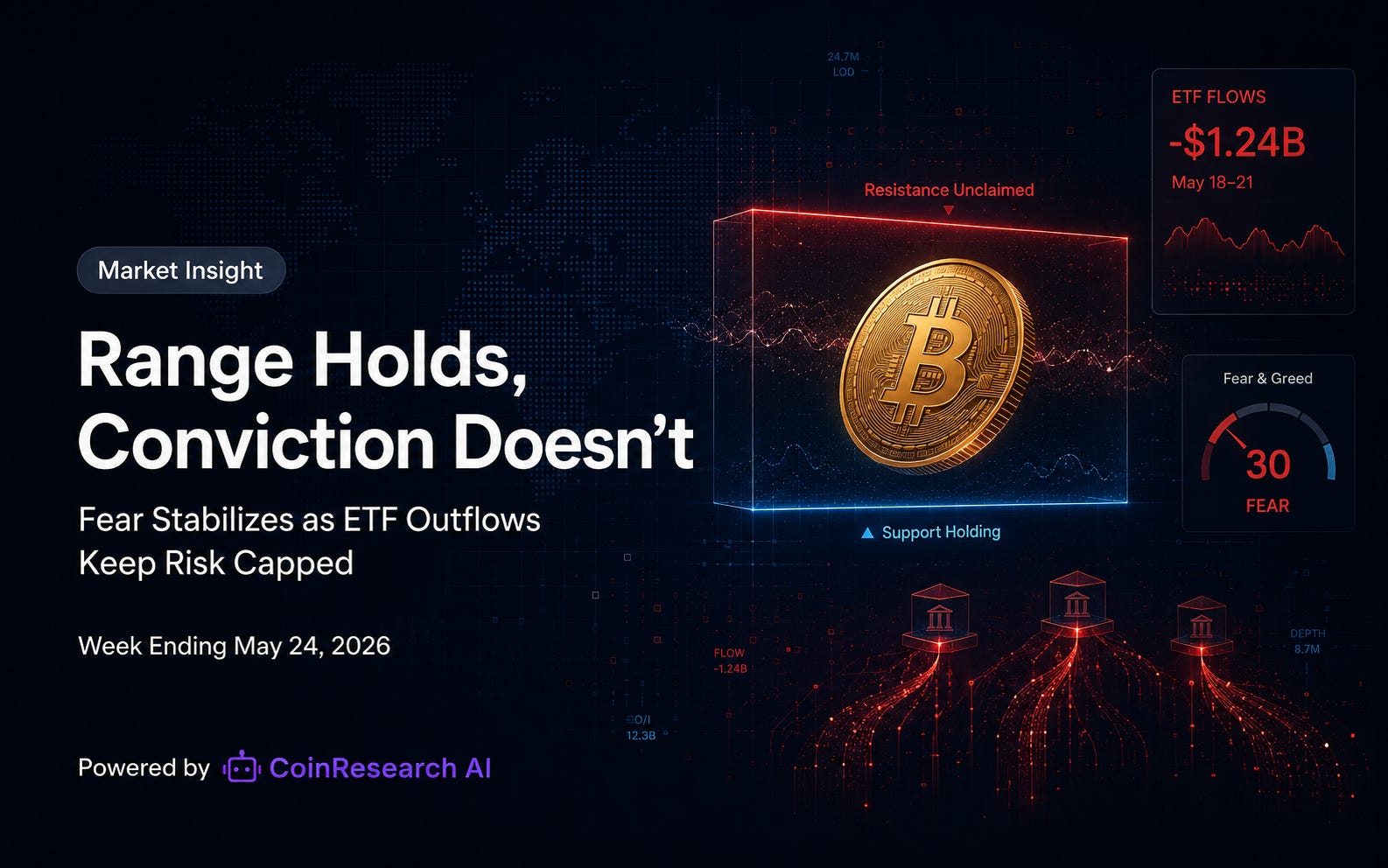
Bitcoin closed the week at approximately $76,988, up just +0.23% W/W from last edition’s $76,814 close — a flat tape that did exactly one thing: it avoided a fresh breakdown. ETH was weaker, closing Sunday near $2,098, down −0.84% W/W. The central tension is simple. BTC defended its range, but the market did not repair the failed 200DMA reclaim that defined last week’s rejection. Holding support is not the same as reclaiming trend, and this week the difference mattered.
The macro tape stayed heavy. Kevin Warsh was sworn in as Fed Chair on Friday May 22 and was unanimously elected FOMC Chair by the committee the same day — moving the market from “incoming-chair uncertainty” to “first-policy-test uncertainty.” The transition is no longer a question; the reaction function is. The University of Michigan final May sentiment index fell to 44.8 — near historic lows — while long-run inflation expectations rose to 3.9%, keeping the rates channel unfriendly for long-duration risk assets. Spot BTC ETF flows stayed under pressure: the visible daily data across May 18–21 showed roughly −$1.24B in net outflows, with the largest single-day drag on May 19. The marginal institutional buyer did not need to sell to cap the market — it only needed to stay absent.
Fear & Greed held in Fear rather than collapsing into fresh panic. Per alternative.me, the index closed the week at 30, after touching 25 (Extreme Fear) on May 24 and printing 28 a week earlier — stabilization, not recovery. The counterpoints are real but narrow: BTC defended the mid-$75K zone on daily closes, ETH’s downside slowed after the prior week’s flush, and total crypto market cap held near $2.65T with BTC dominance around 58.3%. None of that is broad risk appetite. This was a week where range support worked and conviction did not. The thesis for the week ahead: respect the range, demand that entries pay, and do not mistake a support hold for a trend.
Key Themes
BTC defended the range but did not reclaim leadership. The market avoided a clean continuation lower, but the 200DMA zone from #29 (~$82.2K) remains overhead resistance, not reclaimed support. Range repair is not trend repair.
The Warsh Fed is now live. Confirmation risk has passed; communication risk begins now — and it begins with inflation expectations moving the wrong way into a May 28 PCE print.
ETF outflows kept the institutional bid cautious. Roughly −$1.24B left spot BTC ETFs over four sessions. The market did not need new selling pressure to stay capped — absent demand was enough.
Altcoins remain selective, not synchronized. Model output favors idiosyncratic shorts and a single conditional long — consistent with a tape where BTC holds but beta does not broaden.
2. Strengths
BTC did not confirm last week’s breakdown. After the #29 rejection, the bearish continuation trade needed a decisive loss of the mid-$75K area. Instead, BTC closed the week near $76,988, leaving the market range-bound rather than structurally broken. The caveat: holding support is not the same as reclaiming trend.
Sentiment stabilized from panic to controlled fear. Fear & Greed recovered to 30 after touching 25, which suggests sellers are no longer pressing the same emotional extreme seen after the 200DMA failure. The caveat: Fear is still Fear, and the index remains far below the neutral 50 zone that would indicate broader participation.
BTC dominance remains a defensive anchor. CoinGecko’s global dashboard shows BTC dominance around 58.3% and ETH dominance around 9.57%, confirming that capital is still concentrated in the most liquid asset rather than rotating aggressively into speculative beta. The caveat: dominance strength often helps portfolio stability, but it can also suppress altcoin upside.
Ecosystem development did not stop with price. Citrea’s CTR milestone, XMAQUINA’s DEUS launch window, and Cambria’s June mainnet-linked TGE all point to continued primary-market activity. The caveat: launch calendars are not liquidity guarantees, especially when secondary-market sentiment is still cautious.
3. Weaknesses
The ETF bid remains unreliable. The visible May 18 to May 21 BTC ETF flow window points to heavy net outflows, with May 19 standing out as the most damaging session. That weakens the argument that institutional demand is quietly absorbing every dip.
The Fed path is less forgiving than the market wants. Warsh now owns the communication channel, and the market still has to price his reaction function into sticky inflation expectations. The May 28 PCE print becomes the next test, not a background detail.
ETH underperformance is still a warning. ETH closed lower W/W while BTC finished slightly positive, which tells us the market defended the reserve asset but did not reward higher-beta smart-contract exposure. That is not the normal profile of a healthy altcoin recovery.
Model dispersion is bearish beneath the surface. The strongest dashboard setups this week are not broad longs. They are short-biased or conditional. That matters because a resilient BTC close can mask weak structure in single-name altcoins.
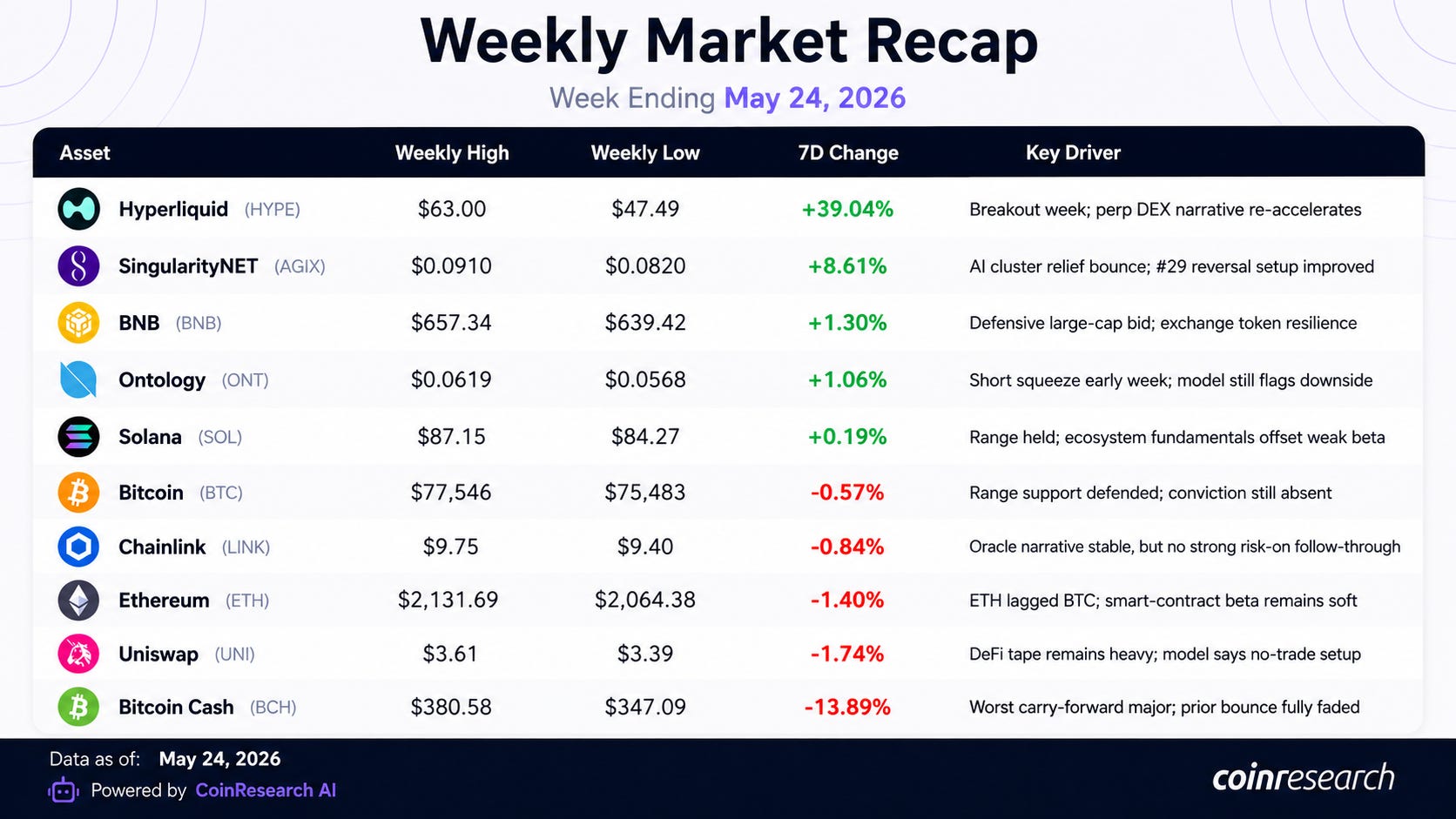
4. Market Recap: Weekly Performance
5. Predictive Analytics & Trade Confluence
Disclaimer: The insights and forecasts presented here are generated by CoinResearch AI’s predictive models and supporting analytics. They are provided for informational and educational purposes only and do not constitute financial advice or investment recommendations. Trading digital assets involves risk, and users should conduct their own research, exercise independent judgment, and use appropriate risk management before making any investment or trading decisions.
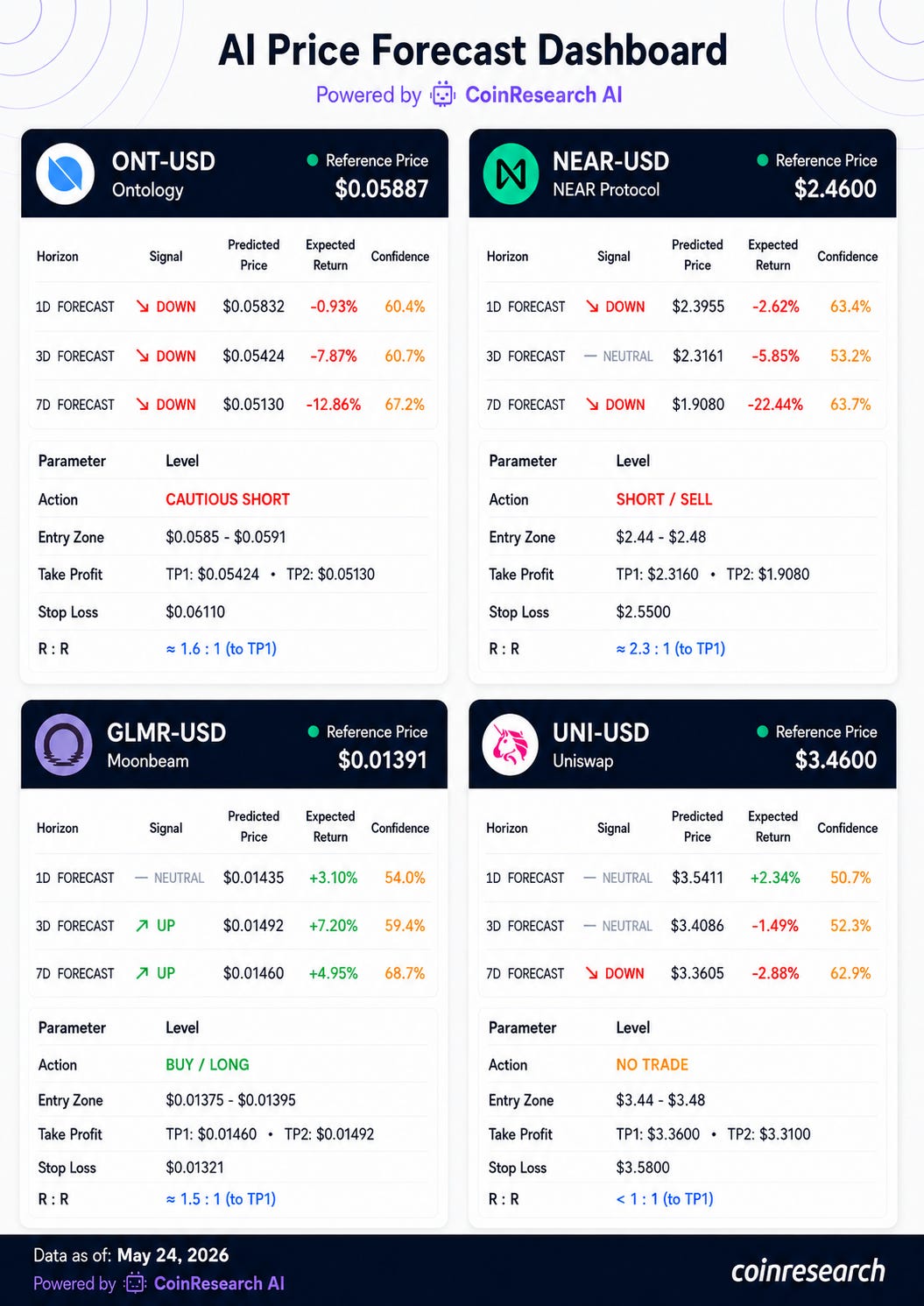
ONT-USD (Ontology)
Reference Price: $0.05887
Market Confluence Analysis. ONT is awkward because the social layer is extremely bullish while the model is directionally bearish. That type of divergence can mean one of two things: either the model is early to a reversal, or social sentiment is lagging a retail-led spike that is already fading. The live CoinGecko check favors caution on entry timing because price has already moved below the dashboard short entry band. Selling into the lower part of the move weakens R:R. The better structure is a relief bounce toward the entry zone, not a market sell after the first leg lower.
Trade Action.
Action: Sell / Short
Entry Zone: $0.0585-$0.0591
Take Profit: TP1 $0.05424 / TP2 $0.05130
Stop Loss: $0.06110
R:R: ≈ 1.6:1 to TP1 from lower entry
Rationale: 3D and 7D forecasts align lower, and the model’s downside target is large enough to justify a short if entry discipline is respected.
Invalidation: A daily close above $0.06110 invalidates the bearish setup.
Analyst Note. The model’s directional read is clean, but the trade is already partially underway. We would not chase below the entry zone. If ONT bounces back toward $0.0585-$0.0591 and fails there, the short is valid. If it grinds higher with social momentum intact, the model could be fighting a crowd-driven squeeze.
NEAR-USD (NEAR Protocol)
Reference Price: $2.46
Market Confluence Analysis. NEAR is the most interesting disagreement in the dashboard. CoinGecko’s live page shows NEAR up strongly over the prior seven days, while the model is calling for downside from a stretched base. That does not automatically make the model wrong. It may be identifying exhaustion after a strong AI-token narrative burst. The problem is execution: price has already slipped below the dashboard entry band, and the clean R:R only exists closer to the upper side of that band. The right trade is not “short NEAR because the model says down.” It is “short NEAR only if the relief bounce fails below invalidation.”
Trade Action.
Action: Sell / Short
Entry Zone: $2.44-$2.48
Take Profit: TP1 $2.3160 / TP2 $1.9080
Stop Loss: $2.5500
R:R: ≈ 2.3:1 to TP1 from upper entry
Rationale: The 7D regression target is severe, while the short-term signal also points lower. The entry must be disciplined because the live move has already started.
Invalidation: A daily close above $2.55 invalidates the short thesis.
Analyst Note. This is a good model short, but not a blind short. NEAR’s social activity is large, and narrative squeezes in AI-linked assets can punish early bearish positioning. We agree with the model only if price rejects near the entry band. Below that, the trade becomes more about chasing than risk management.
GLMR-USD (Moonbeam)
Reference Price: $0.01391
Market Confluence Analysis. GLMR is the only selected long because it has enough model alignment to justify attention, but the live price check weakens the setup. Price has slipped below the dashboard entry band, which can either improve upside if it forms a base or warn that the model signal is early. CoinGecko shows GLMR still down meaningfully on the week, so this is not a momentum breakout. It is a conditional reversal setup. A reclaim of the entry zone would matter more than a small intraday bounce because the social data is positive but not broad enough to carry the trade alone.
Trade Action.
Action: Buy / Long
Entry Zone: $0.01375-$0.01395
Take Profit: TP1 $0.01460 / TP2 $0.01492
Stop Loss: $0.01321
R:R: ≈ 1.5:1 to TP1 from lower entry
Rationale: The 3D and 7D forecasts support upside, and TP1 is anchored to the model’s 7D target.
Invalidation: A daily close below $0.01321 invalidates the reversal setup.
Analyst Note. We like the model structure but not the live tape yet. GLMR needs to reclaim the entry band rather than simply drift below it. The bullish setup is valid only if price stabilizes above $0.01375 with BTC still holding range support. Otherwise, the signal may be early.
UNI-USD (Uniswap)
Reference Price: $3.46
Market Confluence Analysis. UNI is the most useful no-trade example this week. The dashboard is not saying “bullish.” It is saying the bearish signal does not pay enough. CoinGecko shows UNI already trading near the model’s 7D forecast, which means the downside target has compressed before the trade even begins. A short here risks selling too late into limited remaining reward, while the social layer is still strongly positive. That is exactly the type of setup that looks tradable on direction but fails on portfolio construction.
Trade Action.
Action: No Trade
Entry Zone: $3.44-$3.48
Take Profit: TP1 $3.3600 / TP2 $3.3100
Stop Loss: $3.5800
R:R: < 1:1 to TP1 from mid-entry
Rationale: Directional bias is mildly bearish, but the modeled 7D move is too small to compensate for the stop and social contradiction.
Invalidation: No trade unless price rallies into a materially better short entry or the model updates with a larger downside target.
Analyst Note. This is the discipline trade. The market does not pay us for being directionally clever if the R:R is poor. UNI may still drift lower, but the setup does not deserve fresh capital from current levels. No trade is also a trade.
6. Token Launch & Ecosystem Radar
A curated look at three high-signal projects approaching major milestones that have not yet launched their tokens.
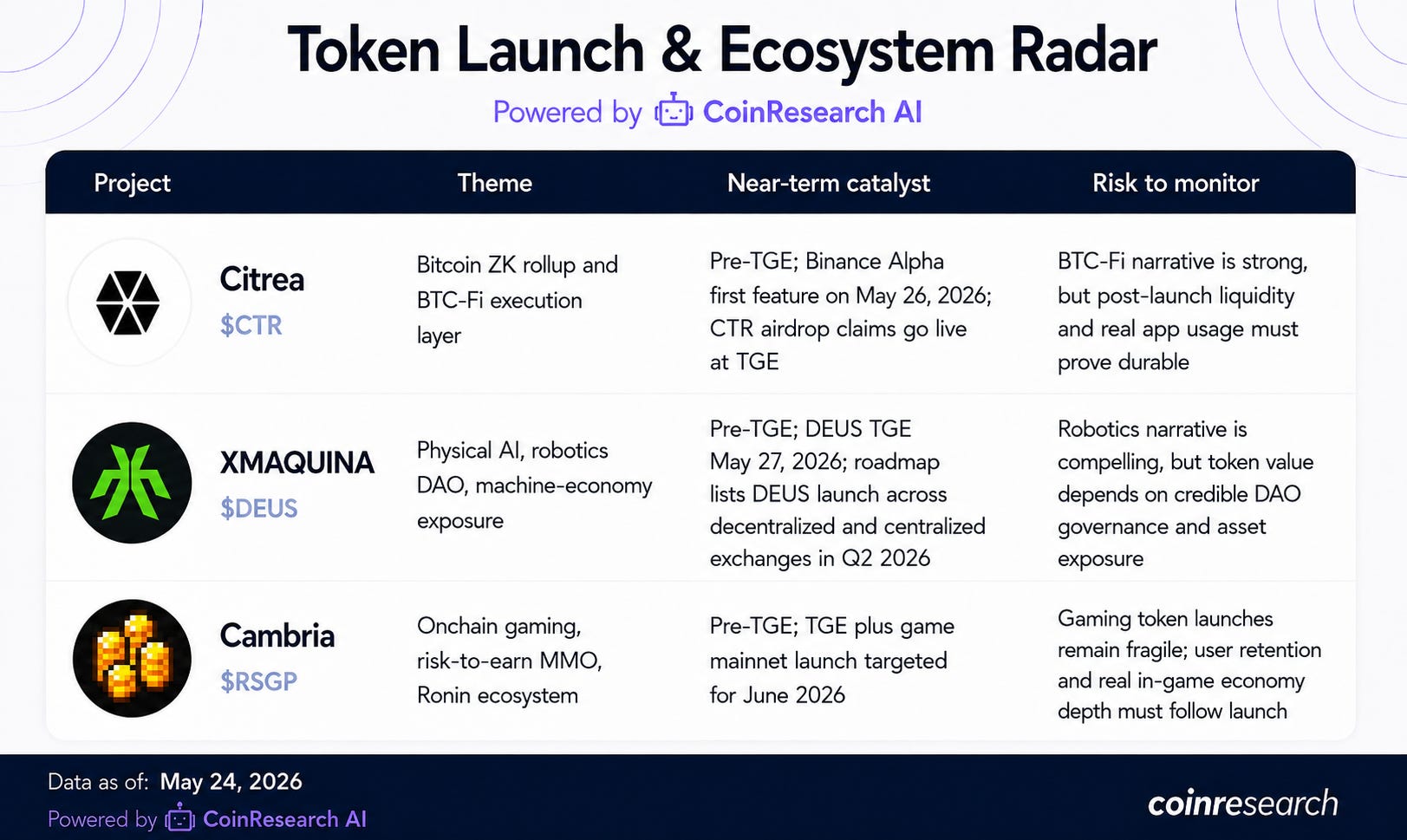
Citrea ($CTR) - A Bitcoin-secured programmable execution layer using zero-knowledge technology.
Why watch it: Citrea sits directly inside the BTC-Fi narrative, but with a stronger technical angle than generic wrapped-BTC liquidity. Its positioning is simple: bring applications, liquidity, and programmable demand to Bitcoin without asking Bitcoin to become Ethereum.
Current Status: Pre-TGE at writing. Citrea’s official airdrop post says claims go live at TGE, while Binance Wallet says Binance Alpha will feature CTR on May 26. The tracker confirms Citrea has not appeared in any prior CRIW radar slot.
Monitoring Rationale: If BTC dominance remains high, BTC-Fi projects are more relevant than usual because they give the market a way to express Bitcoin-led innovation without rotating into weaker altcoin beta.
XMAQUINA ($DEUS) - A Physical AI and robotics DAO focused on decentralized access to humanoid robotics and machine-economy assets.
Why watch it: XMAQUINA is one of the cleaner intersections of DePIN, RWA, robotics, and AI. The project is trying to make robotics exposure more liquid and community-owned rather than purely private-market gated.
Current Status: Pre-TGE at writing. XMAQUINA’s own post references $DEUS TGE | May 27, 2026, while its roadmap lists DEUS TGE in Q2 2026 and describes launch across decentralized and centralized exchanges.
Monitoring Rationale: Physical AI is becoming one of the few AI sub-narratives that still feels tangible. If investors tire of pure “AI agent” abstractions, robotics-linked DePIN could become a higher-signal branch of the same theme.
Cambria ($RSGP) - A browser-based onchain MMO built around risk-to-earn gameplay and Ronin ecosystem distribution.
Why watch it: Cambria is not a generic gaming token story. Its pitch is tied to onchain wagering loops, social competition, and a mainnet economy that must work under real user behavior rather than only trailer-based hype.
Current Status: Pre-TGE at writing. Ronin’s official account referenced RSGP presale activity and indicated TGE + Game Launch on Mainnet: June 2026. The June window is visible, but the exact date should still be monitored before publication updates.
Monitoring Rationale: Gaming has been weak as a sector, but the best candidates are moving away from “play-to-earn” abstraction toward specific, measurable economies. Cambria is worth tracking because the launch is linked to product activation, not just token distribution.
7. Strategic Recap & Forward Outlook
This week resolved one thing and left everything else open. It resolved the immediate breakdown question: BTC did not lose the mid-$75K area on daily closes, and the market did not cascade after last week’s 200DMA rejection. It did not resolve the bigger question: whether crypto can rebuild upside momentum without ETF inflows, easier Fed expectations, or ETH leadership. The result is a market that looks stable at the index level but fragile under the surface. That is why the model portfolio is not aggressively long. The correct posture is selective, risk-defined, and willing to hold cash when the setup does not pay.
Forward Outlook - Week of May 25-31
Macro Watch. The key data point is the April PCE release on May 28. BEA lists May 28 as the next PCE release date, and Barron’s flags Thursday’s PCE print as the week’s pivotal macro event, with markets watching whether inflation pressure confirms or softens the CPI signal.
BTC Key Levels. The first support zone remains the mid-$75K area, where BTC held during the week. The first resistance zone is $77.5K-$78K, where recent daily closes have struggled to sustain follow-through. Above that, the #29 resistance map still matters: the 200DMA zone near $82.2K remains the level that would change the market from range repair to trend repair.
Altcoin Outlook. The market is not rewarding broad beta yet. BTC dominance remains high, ETH dominance remains low, and the strongest model signals this week are short-biased or conditional. That means AI, BTC-Fi, DePIN, and gaming can still produce single-name catalysts, but index-style altcoin exposure remains less attractive than selective positioning.
Model Portfolio Summary. ONT is a SELL only on a disciplined bounce into entry. NEAR is a SELL if it rejects near the upper entry band. GLMR is a BUY only if it reclaims the entry zone and holds above invalidation. UNI is NO TRADE because the downside signal does not compensate for poor R:R.
Disclaimer: This analysis is for informational purposes only and should not be construed as investment advice. Cryptocurrency markets carry substantial risk, including the potential loss of principal. Past performance does not guarantee future results. Always conduct your own due diligence and consult a qualified financial advisor before making investment decisions.
 | A guest post by
|